Sujatha Fernandes Who Can Stop the Drums Pdf
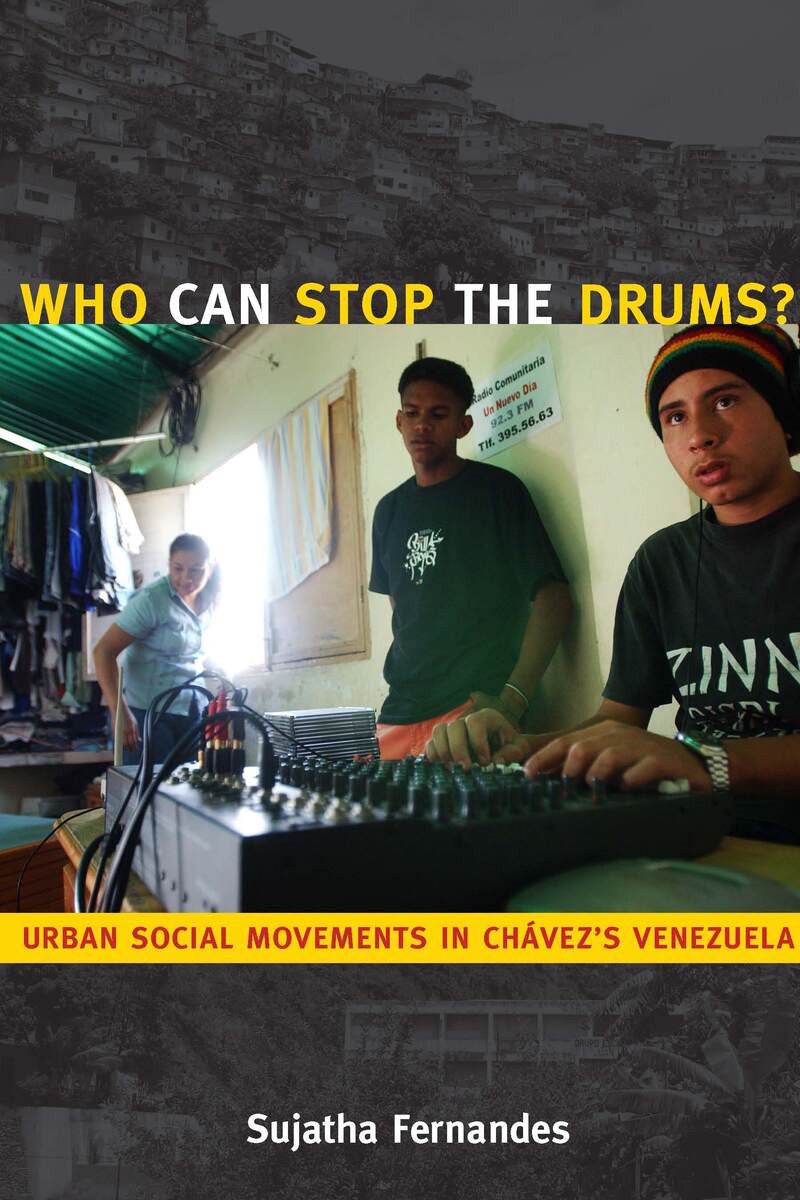
Who Can Terminate the Drums?: Urban Social Movements in Chávez's Venezuela
Duke Academy Press, 2010
Cloth: 978-0-8223-4665-4 | eISBN: 978-0-8223-9170-8 | Paper: 978-0-8223-4677-7
Library of Congress Nomenclature HN363.five.F47 2010
Dewey Decimal Classification 305.562098770905
Virtually THIS Book | Author BIOGRAPHY | REVIEWS | TOC | REQUEST ACCESSIBLE FILE
Nearly THIS BOOK
In this vivid ethnography of social movements in the barrios, or poor shantytowns, of Caracas, Sujatha Fernandes reveals a pregnant dimension of political life in Venezuela since President Hugo Chávez was elected. Fernandes traces the histories of the barrios, from the guerrilla insurgency, movements against displacement, and cultural resistance of the 1960s and 1970s, through the debt crisis of the early 1980s and the neoliberal reforms that followed, to the Chávez period. She weaves barrio residents' life stories into her account of movements for social and economic justice. Who Can Stop the Drums? demonstrates that the transformations under way in Venezuela are shaped past negotiations between the Chávez government and social movements with their own forms of historical retentivity, local organization, and consciousness.
Fernandes portrays everyday life and politics in the shantytowns of Caracas through accounts of customs-based radio, barrio assemblies, and popular fiestas, and the many interviews she conducted with activists and government officials. Most of the barrio activists she presents are Chávez supporters. They come across the leftist president as someone who understands their precarious lives and has made important changes to the state system to redistribute resources. Yet they must residue receiving state resources, which are necessary to fund their community-based projects, with their desire to retain a sense of bureau. Fernandes locates the struggles of the urban poor within Venezuela's transition from neoliberalism to what she calls "postal service-neoliberalism." She contends that in gimmicky Venezuela we find a hybrid state; while Chávez is actively challenging neoliberalism, the state remains subject field to the constraints and logics of global capital.
AUTHOR BIOGRAPHY
Sujatha Fernandes is Associate Professor of Sociology at Queens College and the Graduate Center, City Academy of New York. She is the author of Cuba Represent! Cuban Arts, State Power, and the Making of New Revolutionary Cultures, also published by Knuckles University Press.
REVIEWS
"In the Spirit of Negro Primero is a marvelous contribution to the literature on social movements, neoliberalism, cultural politics, and Venezuela. While most analyses of the country portray Hugo Chávez as either a liberating effigy fighting neoliberalism to help the poor, or an authoritarian caudillo preserving his own power while destroying liberties and human rights, Sujatha Fernandes goes far beyond such polarities. By concentrating on the experiences of poor activists in Caracas, she provides a unique and nuanced perspective on a complicated political process, and reveals the Chávez regime as much more complicated and interesting than most other scholars have allowed."—Nancy Postero, author of Now We Are Citizens: Indigenous Politics in Postal service-Multicultural Bolivia
"Too much of the scholarly and political writing on the Venezuelan government centers on President Hugo Chávez and his fashion and rhetoric. In this original, timely, and important book, Sujatha Fernandes focuses on the barrio residents who form the social base of the Chávista move. Along the way, she demonstrates a detailed understanding of Venezuela's civilisation and recent political history."—Steve Ellner, writer of Rethinking Venezuelan Politics: Grade, Conflict, and the Chávez Phenomenon
"[A]due north fantabulous, well-written, and engaging work of activist scholarship. It provides not only rich empirical information, simply too theoretical insights on some of the key issues confronted past gimmicky Latin American social activists. This book is highly recommended for scholars and activists with an interest in social movements and Latin America."
-- Lynn Horton Contemporary Folklore
"[T]his book certainly adds a flavorful icing, i that is certainly long overdue and more welcome, to the existing literature on Venezuela."
-- J. Michael Ryan Anthropological Quarterly
"Fernandes forges a new and promising analytical approach to the study of social movements: that of examining the 'everyday wars of position.' … If others take upwards Fernandes's research agenda, nosotros volition be rewarded with greater insight into the dynamics of contention inside clientelism and revolution."
-- Leslie C. Gates Perspectives on Politics
"This book is a must read for scholars interested in Venezuela, as [Fernandes] provides an historical account of the growth of Caracas and the human relationship between barrio residents and the state over time. The volume would also be excellent for a graduate form on social movements or social modify, likewise as in a methods course on ethnography as a beautiful example of how to weave together ethnographic and interview data to provide a vivid and intellectually engaging work of scholarship."
-- Tiffany Linton Page Social Forces
"This well written and interesting book captures quite a lot about the ambiguities of urban politics, and the atmospheric condition of barrio life, in Caracas. . . . The volume could certainly be recommended to students with some assurance that they would savour reading it. They volition learn from it at the same time."
-- George Philip Bulletin of Latin American Inquiry
"Fernandes elegantly places the struggles of the local poor in a larger political framework to permit readers to sympathise how residents brand their ain history by negotiating their post-neoliberal visions with their current social circumstances. Recommended."
-- J. M. Santos-Hernindez CHOICE
"Sujatha Fernandes reveals a globe of activism deeply influenced by the history of Left movements in Latin America, only vulnerable to the kind of technocratic, bottom-line reasoning regrettably necessary for the land's economic success."
-- Nicholas Gamso Social Text
Tabular array OF CONTENTS
- List of Illustrations
Acknowledgments
Introduction
I. Private and Collective Histories
1. Urban Political Histories
two. Poverty, Violence, and the Neoliberal Turn
3. Personal Lives
2. Everyday Life and Politics
4. Culture, Identity, and Urban Movements
5. Barrio-Based Media and Communications
6. The Takeover of the Alameda Theater
III. State-Society Mediation
7. The New Coalitional Politics of Social Movements
Conclusion
Notes
Bibliography
Index
Request Accessible FILE
If yous are a student who cannot use this book in printed form, BiblioVault may be able to supply you with an electronic file for alternative access.
Please have the accessibility coordinator at your schoolhouse fill out this class.
Information technology can take 2-3 weeks for requests to be filled.
Nearby on shelf for Social history and conditions. Social problems. Social reform / Past region or land:
9780816523306
9780226041988
Source: https://www.bibliovault.org/BV.book.epl?ISBN=9780822346777

Post a Comment for "Sujatha Fernandes Who Can Stop the Drums Pdf"